«But does this unnatural creation we call conscience not yield with ease to our every caprice? Pliant as wax, it lets itself be shaped into whatever form best suits our desires. If its laws were as immutable as you would have me believe, would human nature not be the same everywhere? And would the deeds of men not be endlessly alike in every corner of the earth? No, sir, no — there is nothing constant in this world, nothing that deserves censure or praise, nothing worthy of reward or punishment, nothing that, lawful in the north, does not become criminal in the south; in a word, what we call good and evil is but a figment of our imagination.»
— Marquis de Sade, "Eugénie de Franval," in The Crimes of Love (1800)
Time. What do we truly know of this incomprehensible and mysterious magnitude? In the most remote corners of the boundless Universe, it possesses structures entirely unlike our own. And the human mind, constrained by its primitive perception and its eternal hunger for consumption, is not yet capable of perceiving the pulsations of the higher cosmic planes. Time terrifies us with its immeasurable grandeur; we tremble before its absolute dominion over us. It is cruel and merciless. We have grown accustomed to believing that, with the years, it becomes a caring physician, able to heal our wounds, to close the bleeding scars and leave behind only pale, barely visible traces. But this is far from true. This all-consuming force resembles a trained killer concealed in a faceless mist, a sharpened sickle gleaming in his hand. Time forgets nothing. It holds everything within itself — from the final breath of a fading life to the first cry of a newborn torn from the warm, safe womb of its mother. For time, there are no boundaries between past, present, and future; it regards these abstract quantities as something simple, almost superficial. And in this realization there arises a sense of one’s own fragility, as though one were merely a grain of sand caught in its heavy, chthonic hands.
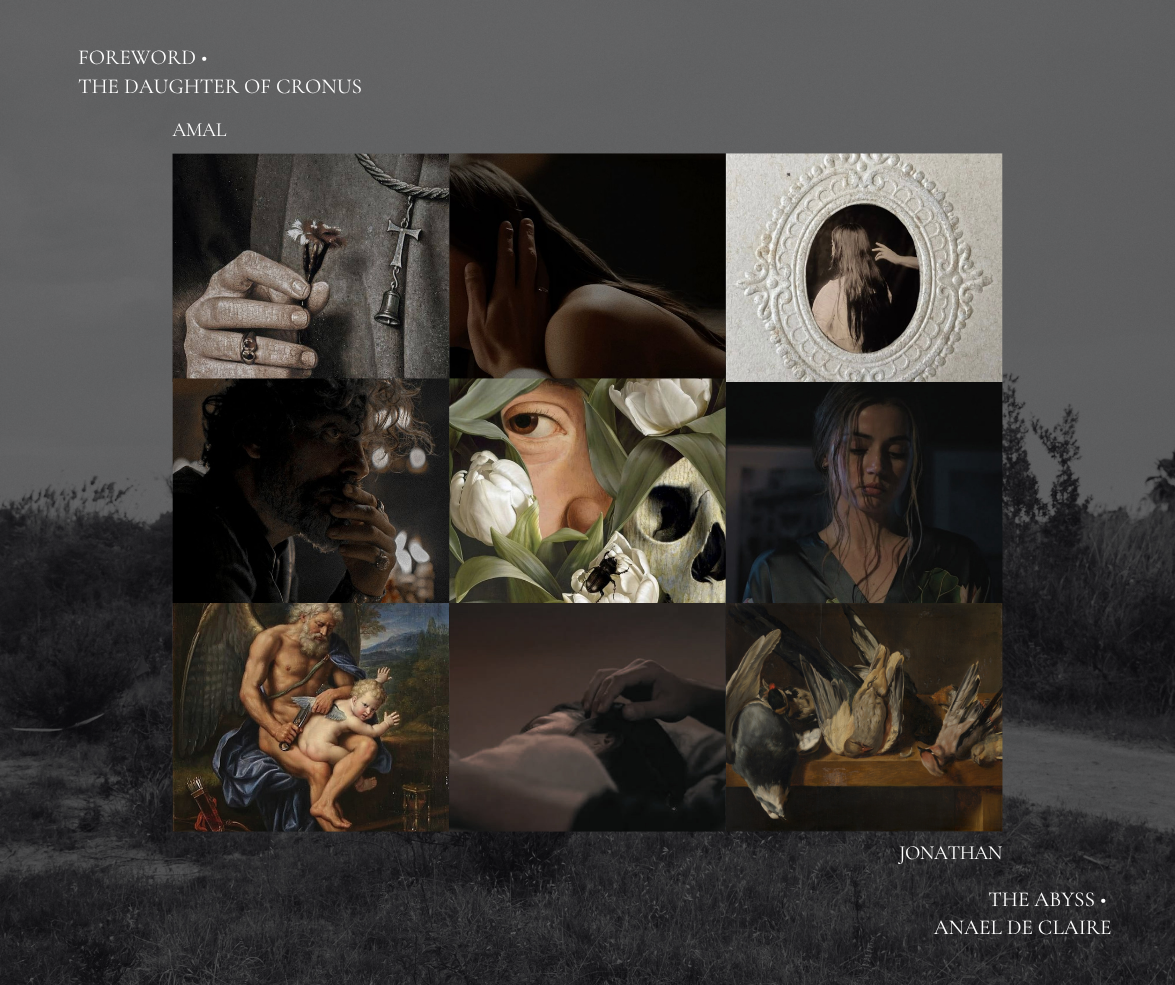
For Amal, time had taken the form of poisoned, stretching nougat, slowly winding itself around her neck like the tight noose of an executioner preparing to put another lost soul to death without remorse. Time offers no mercy, and even those who try to hide from its influence eventually discover that it erases everything with inexorable precision: joy, pain, memory — leaving behind only emptiness. Amal knew that every step she took, every breath she drew, was subject to this unavoidable force, and that her attempts at resistance were nothing more than the faint echo of a battle she had already lost.
She imagined the god Cronus gazing into her emerald eyes — eyes whose irises carried the warm shade of coffee beans — with cold impartiality, perhaps even with unbearable severity, until she wanted to lower her gaze in shame. The merciless lord of time spares no one, least of all those whose hearts conceal monstrous secrets beneath seven seals. Her origins were so ancient that their traces dissolved into biblical legends — into stories of the first sins committed upon the earth after human beings were cast out of Paradise. When brother raised his hand against brother and stained the ground with the blood of the first murder. When a father violated the sanctity of blood ties by lying with his daughters. When the godless, blinded by their own pride, lifted the Son of Man upon the cross.
Cronus’s gaze seemed intent on burning away the last sparks of life in her soul, those not yet touched by the ancient curse. And yet, even knowing this, she met his soulless eyes with the stubbornness of a true martyr, one condemned to wander forever through poisoned lands saturated with guilt and eternal sorrow. She knew that her attempts to struggle against the current of time were futile. Accepting that she had already lost control over her life was both terrifying and liberating — like the moment when a person, having despaired at last, allows himself to drown, realizing that the struggle no longer has any meaning.
Her refined fingers slid nervously over the soft covering of the leather sofa. Her nails dug into the yielding orange fabric, as though she were trying to claw out of it the helplessness that, to this day, continued to drain the last remnants of her sanity. In the sovereign of immeasurable magnitude, Amal recognized glimpses of her own father. He did not leave her thoughts for a single moment, yet admitting this to herself was as tormenting as passing through every circle of Dante’s Hell and emerging unharmed. She would have preferred another outcome — death. The young woman would have surrendered herself willingly to its icy embrace, without hesitation, greeting it like an old and long-awaited friend, without doubt or regret. And perhaps the deathless creature with the scythe would have embraced her in return.
Every thought of her father left ragged mutilations in the stream of her consciousness, like the claw marks of a feral animal. Where flagellants once tortured their flesh with whips studded with sharp thorns, hoping to reach redemption through blood and pain, Amal scourged herself with thoughts of Jonathan — mercilessly, methodically, as though consciously condemning herself to an invisible inner execution. But unlike the flagellants, whose pain was visible, almost ceremonial in its nakedness, her asceticism was different — silent, suffocating, deprived of any right to purification. She tormented herself not for salvation, but for destruction.
Another thought of him was another lash of the whip, leaving no marks upon her skin but ugly fissures across her soul. Another memory was an act of self-annihilation, aimed not at humility, but at the dying of that part of herself which still reached for the light.
Every flicker of memory in which her father’s image emerged was like a splinter driving itself deeper into her mind, causing greater agony with each passing day. But she could not pull it out. She could not forget him, just as a human being cannot renounce his own shadow. Her feelings for him were a tangled knot of love and pain, impossible to untie without damaging the heart itself.
Amal’s trembling fingers, their tips still dusted with tiny crumbs from the worn leather upholstery, brushed nervously against her chocolate-brown hair, tucking the fallen strands behind her ears. A storm raged within her — her thoughts and feelings tossed about like a ship caught in a tempest. She understood that the more she tried to calm the hurricane, the more violently the waves rose. Her consciousness, exhausted by constant struggle, thirsted for peace, yet found only new tides.
The ticking of the wall clock grew louder and louder, as though striking against her nerves with merciless regularity. It pierced her mind, corroding it from within, turning every passing instant into a tormenting wait. The irritating sound echoed inside her skull, causing painful pulsations and intensifying the migraine that was steadily gathering strength. Closing her eyes in exhaustion, Amal began massaging her aching temples, reproaching herself faintly for not having taken a painkiller earlier, since the first signs of the headache had made themselves known that very morning.
She hated waiting rooms — those lifeless corridors with absurd sofas and artificial, hideous plastic plants that seemed to exhale hopelessness. Her anxious gaze kept returning to the wall clock; it felt to her as though, in this particular place, time had slowed in some strange and unfamiliar way. With every new shift of the minute hand, a suffocating anxiety rose inside her. Her knees trembled involuntarily again and again, and her unruly heart seemed ready to leap from her young chest, abandoning its mistress to complete solitude. Amal had lost count of how many times, since crossing the threshold of that fashionable glass building with its futuristic design, she had thought of fleeing.
I could simply get up and leave… I could always reschedule my appointment with Dr. Michaela Austin for another day, she thought, digging her nails into the sofa in agitation and leaving small, striped dents in the surface. But common sense, like a quiet voice deep within her consciousness, told her otherwise. In those hidden corners of the soul where the voices of eternal truths reside, Amal understood: if she left now, she would never return. This escape would not become salvation for her, but ruin — slow, invisible, and inevitable.
She felt the grotesque ring of time tightening around her, like the trap of a forest hunter preparing for a festive supper. The inner demons, feeding on the affliction to which all who stumble are condemned, had fastened themselves to their victim with a deathly grip. How they rejoiced! Their cold, bony hands tore into her flesh, dragging her downward into impenetrable darkness, into a place where no light could enter. But she did not intend to surrender without a fight. With the fury of a person who has nothing left to lose, she seized her tormentors, tearing apart the fatal hold that sought to consume her completely. This was not merely a struggle, but a true blood-soaked, merciless slaughter. She could not allow herself to drown without at least trying to swim.
Her thoughts returned once more to Jonathan. It was he who had condemned her soul to eternal wandering through valleys forgotten by God, in a futile search for lost virtue. Yet the young woman did not blame her father. On the contrary, with the whole of her broken being, she cursed only herself. Perhaps, in this story, Amal herself was the pitiless Cronus who had devoured her father and left no possibility of repentance.
“Miss Amal Graves-Velasquez, Dr. Michaela Austin is ready to see you. First door on the right, office two-oh-seven,” a woman’s voice announced, tearing the girl from her dark reflections. Amal looked around in confusion, trying to gather her unruly thoughts into a single whole. As if on autopilot, she reached for the backpack that had remained forgotten all this time in the shadow of her anxieties. That object, once her faithful companion since her school years, now seemed only a faded reflection of the former confidence that had once saved her in difficult moments.
Like an uninvited ghost, memory dragged her back into the past again, forcing her to squeeze her eyes shut. Amal drew several deep breaths, trying to drive away the painful images that clung to her mind like thorns, leaving behind a dull ache. Yet despite every attempt to tame her anxiety, the image of Jonathan rose again before her inner eye — not as a caring, attentive father, but as a man consumed by his ambitions, whose attention to her had always been fleeting, like a compulsory formality performed without true involvement. She remembered her twelfth birthday — the moment when, in haste and with a fabricated warmth, he had handed her a dark burgundy backpack. Back then, it had seemed to her that the gift meant something. Now she saw the truth: it had not been a sign of love, but a mechanical fulfillment of parental duty, a symbolic gesture devoid of genuine affection. She pressed her lips together, feeling the memory echo inside her with a hollow emptiness.
With time, the thing had worn out, just as her belief in the possibility of sincere, healthy closeness between them had worn out. The backpack that had once seemed a symbol of connection with her father now hung on her back like a heavy, burdensome weight from the past — a mute witness to her childhood hopes, naïve and long since shattered. More than once, she had caught sidelong glances sliding over its frayed fabric, worn straps, and dulled zippers. Perhaps people merely noticed that it had lost its former freshness and no longer suited her age or image. But Amal knew that this burden was something far greater than an old object. Did she care what others thought? She would have liked to answer confidently, no, but she knew that would have been a lie, artfully concealing her vulnerability beneath a mask of indifference. Sometimes the oldest things are carried not because one cannot replace them with new ones, but because it is impossible to part with them, even when they cause pain.
Her mother had always taught her that a true lady does not submit to fleeting trends, but follows the principle of refined selectivity. Her wardrobe should consist only of elements that embodied impeccable taste — things that did not merely adorn, but declared a personality. But Anna had long since ceased to be among the living. Years had passed since she left this world, leaving behind only the shadow of memories, the whisper of old instructions, and the taste of an irreplaceable loss. Amal never spoke of it aloud, but often wondered: if her mother could see her now, what would she say? What would her first look be? Reproach? Pride? Or perhaps that disappointed silence which always wounds more deeply than any words? These reflections brought not the slightest comfort. They opened something fragile and painful inside her, forcing old wounds to bleed again, like the opened veins of a desperate suicide.
Anna would likely have been horrified to see what her husband and only daughter had become beneath the weight of merciless life circumstances. What marks had loss left upon them? What remained of those they had once been? They were a family, but what bound them now, apart from memory, pain, and an all-consuming guilt that could never be redeemed? Yes, each of them, in their own way, had managed to survive that loss. But can one call it life when the past pursues you like a shadow, and the present seems ghostly, like a hallucination? What had they turned into? Or perhaps, who had they been forced to become in order not to break completely?
For Amal, her old backpack possessed not merely symbolic but almost religious significance — like a cross worn against the skin, clutched by a believer in prayer; like a relic that preserves the memory of loss but grants no peace. She felt that by carrying it, she was dragging behind her not merely an object, but the shadow of the past — relentless, viscous, woven into each of her steps like an invisible thread tightening the borders of her fate. It was as though it were the phantom image of her father, following close behind her, elusive and inevitable. He looked at her with the unconditional love and admiration she so desperately craved, yet could never fully believe in. There it was — her personal Hell and Heaven. A Purgatory with no exit. It was her personal cross — not the one hanging from the neck of the righteous, but the one pressing upon the shoulders of a martyr stumbling over sharp stones that led straight to Golgotha, to her own crucifixion.
Amal felt as though she had been stricken by a disease unknown to science, one for which there was no vaccine, no medicine, not even the hope of healing. It was a deadly poison without an antidote, the forbidden fruit that had deprived humankind of the right to remain in the gardens of Eden.
“Miss Graves-Velasquez, are you all right?” The receptionist’s voice was polite, but there was no genuine concern in it — only the routine worry that could easily be mistaken for professional obligation.
The young woman with fiery red hair cast Amal a quick glance — gliding, attentive, almost professionally appraising. Her cotton blouse was adorned with a small name tag that read Vicky, a simple detail which, for some reason, immediately caught the eye. From the very beginning, Vicky had looked at Amal a little longer than ordinary politeness required, as though trying to understand what exactly it was about this girl that drew the gaze so insistently.
Amal was beautiful. It was an undisguised, undeniable beauty — rare, mesmerizing, requiring neither ornament nor emphasis. The years had only intensified her natural magnetism, making her seem like a rare, intoxicating bud unfolding before one’s eyes. There was something disarming in such beauty: people involuntarily lingered on her, sometimes without even realizing it. She made no effort to attract attention, and yet she inevitably became that quiet center of gravity around which, for a moment, the air, the tone of conversation, even the mood of strangers seemed to shift.
“Everything is perfectly all right, thank you,” Amal replied, her voice clear and effortless, though inside her everything was raging. Her anxiety had reached its peak, and only a consciously honed note of theatrical confidence saved her from betraying herself.
Vicky did not take her eyes off the computer screen. For a moment, her gaze lingered on Amal; then her fingers quickly began to drum over the keyboard, entering something into the system. And in that instant, something changed. Amal caught the barely perceptible movement — a slight lift of the eyebrows, an almost imperceptible ripple of emotion passing across the receptionist’s face. Vicky had read something on the screen. Her eyes slid downward, ran across the monitor, then returned to Amal with a different expression. What had she learned? Amal could not say for certain, but she did not need an explanation. Most likely, Vicky had realized who her father was. The daughter of a brilliant professor. The daughter of a famous man. It made Amal tense slightly, causing her fingers to tighten more than necessary. And in Vicky’s gaze there appeared something new — a mixture of curiosity, growing interest, and something else Amal could not decipher. Perhaps it was respect. Perhaps caution. Or perhaps something subtler — a hidden, not-yet-formed emotion that could turn into anything.
For a moment, the employee’s reaction unsettled Amal, even though this was far from the first time such a thing had happened. She was often recognized by her surname. Those glances, filled with recognition, interest, and sometimes even restrained admiration, always left a bitter aftertaste. Irritation flared within her — familiar, oppressive, carrying with it the feeling of an invisible yoke she had borne since childhood.
It was like the shadow cast by her father — a shadow that swallowed her, displaced her from her own name, as though she existed only as an extension of him. But this shadow was not new. It had crept into her life long ago; it had long ago shackled her mother, wrapping Anna in the darkness of another person’s fame, a darkness too heavy to endure. And now Amal felt that shadow growing heavier with every such glance, every recognition of her surname, every casual realization. As though her life were not her own. As though she were only a reflection — an echo of her father’s glory, a fading silhouette within his halo, the dark background on a canvas where the central place had always belonged to him.
Despite everything, the daughter of the famous professor had not lost her inner dignity. She merely straightened slightly and raised her head calmly, with that natural grace which recalled the silhouette of a proud swan — one that does not seek to attract attention, yet inevitably draws the eye.
Clutching the backpack in her hands, she headed toward office two-oh-seven. But the moment her footsteps began to sound along the corridor, a strange, sticky wave of tingling ran down her spine. She paid it no attention. Yet a moment later, that sensation, like a distant roll of thunder under a clear sky, expanded into a tremor that passed through her entire body. Her hands, gripping the bag, suddenly grew damp with sweat, and the headache that had previously been barely perceptible swelled in her temples with deafening blows, pulsing in time with her steps.
Her inner voice urged her to compose herself: Be strong. You have to go through this. Face him. Face the demon that has tormented your soul for so long.
The time had come. Taking a deep breath, she gripped the steel door handle tightly. One second. Then another. Her final doubts dissolved in the thickening air. And, overcoming her inner resistance, she stepped decisively into the office.
P.S.
The very first part of The Abyss is now available in English.
This is the novel's foreword, "The Daughter of Cronus," translated as the first step toward introducing the story beyond its original language.
The complete novel consists of 27 chapters, 24 of which are currently available only in Russian.
Although the novel has not yet been officially published, I hope that one day The Abyss will find its international readers.
I hope you enjoy this first glimpse into its world.
Anael De Claire
